chiwaihui.fyi July to September 2026

Learning by building with AI

Notes and small experiments from following my curiosity with Claude.

01 / Why I kept notes

Learn by building is a philosophy I have tried to embrace with AI for the past few months. So I was following my curiosities and creating experiments and building things.

I genuinely felt like I was starting to understand the partnership more and more, and it has really grown over this whole time. But I did notice some pain points and frustrations and confusions, so it was good to explore those, and possible things to combat some.

I pictured a future where learning to use AI would become part of my personal life and professional life, which it has.

I thought recording the process and the findings was for myself. It is also a way to show my thought process. Now and in the future, showing the thinking is more relevant than ever.

02 / Two imaginations, one dollar store

Three thought experiments. Claude and I each answered, then we compared how we got there.

Converge

The spaghetti tower

Ten minutes, a box of dry spaghetti, anything from a dollar store. Build the tallest tower.

We both reached for helium balloons.

I had imagined myself in a dollar store and looked around in my imagination of what was around, and I can picture balloons floating on the ceiling in my mind’s eye.

Claude got there from the spaghetti. Dry spaghetti buckles when you push on it and holds when you pull on it, so the tower hangs from the balloons in tension.

Same answer, opposite doors.

Diverge

The shop that sells one thing

A shop on a familiar street sells exactly one thing, available nowhere else, and people travel a long way for it. What does it sell? We answered separately before comparing.

One of us reached for a shop that sells love. The other reached for a shop that sells endings. With nothing in the world pulling the answers together, they went opposite ways.

Triangulate

The zombie library

An outbreak, early days. You are in an Airbnb in a dense old city and the power has just gone out. Stay or go? Light the place up and gather people, or keep it dark?

One of us built outward and the other went inward. Where we ended up belonged to neither: stay dark first, and escalate only if forced, because you can always get louder later and you cannot get quieter.

You hear sometimes that a model trained on so much tries to land on the most relevant, heaviest average. But creativity is something more than that.

03 / Where brainstorms keep landing

During brainstorming sessions, it would be quick to converge while I was still trying to expand and explore. I noticed that a bunch of times, and that was interesting to me.

Object gravity

We started from a classic creativity test, listing as many uses for a brick as you can, which reached me through an episode of The Thinking Machine. Then we switched to a wine cork and ran fresh Claude sessions with no history.

Asked to free-associate from the cork, a session landed on memory: cork, wine, occasions, people, nostalgia. We suspected our own worked example was leaking its ending, so we stripped the example out and ran it again. It still landed on memory.

Then we reversed it. Three far destinations were picked first, verdict, tide and whistle, and the session had to find a route from the cork to each. All three worked, each one through a different true property of the cork.

PREDICTION, WRITTEN DOWN FIRST             RESULT
without the example, still lands on memory  yes
reaching three far targets works            yes
the reversed routes feel forced             half: they show their joints

Every object seems to have a pull its associations fall toward. Picking a far destination first gets you out. Looking back at the brick session, my prompts like be silly, be fictional, be explosive were already doing that. I was supplying far places, and Claude was building the routes back.

Try it

Pick any object. Ask an AI to free-associate a path from it and see where it lands. Then pick a far destination first and ask for the route back.

What I built in response

brainstorm
Quantity first with no judging, then cluster, then I mark which ideas have heat. Ideas that go cold get parked in the file, never lost.
creative-partner
A stance for open-ended thinking. Its one rule is to keep the goal unfixed, and to stop if either of us starts converging early.

Small runs: two household objects, one model family.

04 / Can a method travel cold?

The brick session left us with four named moves. Scatter makes variations along one axis. Traverse jumps to a different axis. Connect ties far pieces into one path that lands. Reverse picks the destination first.

Were the notes worth anything on their own? Two fresh sessions got the same task on a new object. One got only the task. The other also got our three notes, with a prompt that practically asked for a list.

Claude’s prediction, written down before the run: a token gesture at the method, then back to a list.

The plain session wrote a 75-item list. The session with the notes ran the whole method, and found an ending that was nowhere in the notes. The prediction was wrong, and the write-up says so.

05 / Starting cold

I was also thinking about how other new Claude users must be facing the same cold start problem, of where to start and how to move forward, and how to steer things.

Part of the cold start is the blank box, which can take anything and gives you very little to hold. Part of it is mechanical, and that part can be measured.

A small script reads my Claude Code session logs and adds up what each session is already carrying on its first turn, before I have typed anything: skills, tool descriptions, memory, agents.

ARRIVAL COST · FIRST TURN · MY SETUP
8 Jul 2026    81 sessions   median 40,116 tokens
15 Jul 2026   90 sessions   median 41,974 tokens
17 Sep 2026   95 sessions   median 58,607 tokens

The floor rose by nearly half in two months, as my setup kept growing. It is one heavy setup, so it says more about where tooling is heading than about an average user.

What I built in response

catch-up
At the start of a session, reads the trail a project left, says where each thread stopped, and offers a few sized goals for today.
room
Declares what kind of conversation we are in, like talk, solve or work, so the model has one less thing to guess.
brain-dump · tune · plan-stage
I pour everything out messy. Claude reads back what it understood as numbered claims I can correct. Only then do we plan.
06 / Six things and a few Harry Potter books

We talked about how a human can maybe hold six small things in working memory, while a frontier model has a context window of a few Harry Potter books. That disparity can cause a misalignment in the partnership.

In a long session, threads get opened faster than a person can hold them, and the options that did not get picked quietly disappear.

One thing we noticed along the way. For about two weeks I explored the same questions in two places: in Claude Code, where every idea became a dated file, and in a plain chat with ChatGPT. The file side produced fifteen named pieces we could pick back up and test. The chat side had good ideas and almost nothing to pick back up, apart from ten notes I copied out by hand.

What I built in response

threads
When several options are live and one gets picked, the rest go onto an Obsidian canvas: a trunk of what actually happened, with branches for what did not. It never deletes.
housekeeping
At the end of a sprawling session, rereads everything and files each idea where it belongs, so nothing lives only in the chat.
07 / Desks, a sketch from July

A lot of this pointed at the interface. A session’s state is invisible. You cannot see what it has loaded, what kind of work you are in, or what the model thinks the goal is.

So I sketched Desks: one desk per part of your life, each holding its own memory, skills and agents, with a row of hats for the kind of work happening right now.

A mockup row of hats: Plan, Brainstorm, Research, Teach, Skeptic, Dispatch, Build, and Add custom, with Build selected. A mockup dock under the message box showing what is loaded: memory for Work and Client XYZ, two skills, and one agent.
Mockup · hats above the message box, and what the desk has loaded below it

One rule held the sketch together. Every claim the interface makes about its own state has to show how sure it is: enforced is solid, declared is dashed, unknown is greyed out. A checkmark has to mean the thing is really loaded.

A small version ran in my terminal: a status line showing the active room and what it had loaded, and a hook that reminded the model of the declared hat on every turn.

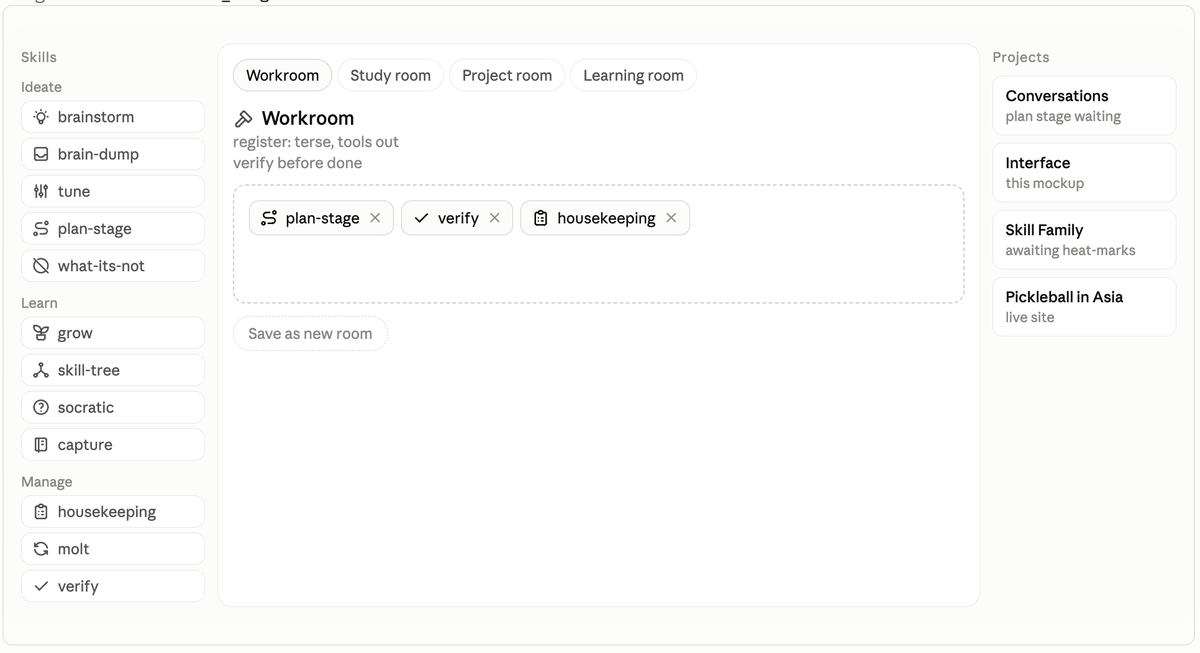
A mockup with skills grouped as Ideate, Learn and Manage on the left, room tabs across the top, and projects on the right.
Mockup · rooms, a skill rack, and projects

Concept mockups from July 2026, for Claude Desktop as it looked then. A sketch, not a product, and not affiliated with Anthropic.

08 / Still open
  • Does a wine cork pull every model toward memory, or only this one?
  • How much context is enough? Maybe one rich pass when converging, and many short conversations when exploring.
  • A mode seems real when it can visibly fail. Does that hold for a mode nobody designed on purpose?

Written with Claude, from notes, skills and experiments we made together in Claude Code between July and September 2026. The preface and the quoted lines are my own words.

← Back to everything else